Why the Internet's Favorite "Unicorn Hunter" Website Is Bullshit

Someone just linked you that site, didn't they?
You were in a forum, a subreddit, maybe a dating app comment section. You mentioned, carefully, maybe even nervously, that you and your partner are interested in dating someone together. Or maybe you're the person who's dating a couple and wanted advice. Or maybe you're already in a happy triad and made the mistake of saying so out loud.
And someone dropped the link. Unicorns-R-Us. Like a judge handing down a sentence.
Here's how it usually goes. A couple posts something like: "Hey folks, we're a happy couple interested in finding a partner to build something with. Any advice?" Within minutes, the comments roll in. Someone posts the link by itself, no context, no explanation. Someone else adds: "Read this before you hurt someone." A few more pile on with variations of "This is textbook unicorn hunting" and "Please educate yourselves." The original poster, who came in excited and open and genuinely trying to do the right thing, gets buried in hostility from a community that's supposed to be about openness and acceptance.
If the poster is a "unicorn," someone already in a triad or thinking about joining one, it's even worse. They get told their relationship is inherently exploitative. They get told they're being taken advantage of, even if they're perfectly happy. They get linked that site like it's a medical diagnosis.
So you read it. And now you feel like shit. Because according to that site, what you want, or what you already have, is basically impossible, probably unethical, and almost certainly going to hurt someone.
Here's the thing: that site isn't entirely wrong. But it's not entirely right either. And the way it gets used? That's where the real damage happens.
I'm not here to tell you that harmful behavior doesn't exist. It does. I'm here to tell you that a website written with sarcasm, sweeping claims, and zero actual data has become the internet's go-to tool for shaming people out of an entire relationship structure. And that's a problem worth taking apart.
What that site actually gets wrong
Let me be clear about what I'm doing here. I'm not saying "ignore all warnings" or "every couple seeking a partner is doing it right." I'm saying that Unicorns-R-Us mixes real ethical concerns with unsupported claims, loaded definitions, and a tone that was practically designed to be used as a weapon. Those things are worth separating.
Here are the biggest problems.
It defines the problem in a way that traps everyone
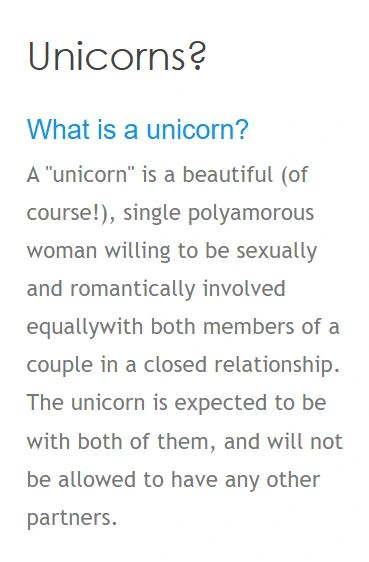
Unicorns-R-Us definition of "Unicorn" from the top of their page
Right at the top of the site, a "unicorn" is defined as a person expected to be equally involved with both members of a couple, in a closed relationship, with no outside partners. The site then spends thousands of words explaining why that specific arrangement is doomed.
But here's the trick: they defined it to be doomed.
They took the most rigid, unrealistic version of the arrangement (forced equal love, no autonomy, no negotiation) and then said "see? It doesn't work." That's rigging the question so the answer is always "no," then acting like they proved something.
On another page, the site goes further, claiming that "in all recorded human history, nobody has ever fallen in love with two different people at the same rate in the same way at the same time." That's not a finding. That's not even a testable claim. It's rhetoric dressed up as a universal truth, and it's designed to make anyone who believes their own experience feel naive for doing so.
A couple who wants a closed triad but doesn't demand forced symmetry, doesn't impose one-sided rules, and genuinely treats their new partner as someone with a real voice? They don't fit the site's own definition. But they'll read it and see themselves condemned anyway, because the site makes no real effort to separate "rigid, controlling couple with a fantasy checklist" from "two people who love each other and want to find someone who fits into their life."
And that collapse, where very different things get jammed under one dirty label, is the engine of the entire problem.
Because when the internet says "unicorn hunter," it could mean:
- A couple looking for casual group sex — a swinging context where the original term "unicorn" actually fits
- A couple genuinely seeking a long-term partner to build something real with
- A couple treating a new person as a disposable accessory with one-sided rules — the actual harmful pattern that deserves the label
These are not the same thing. The site treats them as if they are. And then the internet runs with it.
This isn't a minor oversight. It's the foundation crack that the whole site is built on.
The word "unicorn" started in 1970s swinger communities.1 In that world, a "unicorn" was a single bisexual woman willing to join a couple for casual, recreational sex. The expectations were openly sexual, openly temporary, and openly recreational. Nobody was pretending it was a love story. The term described rarity, not exploitation.
That term migrated into polyamory forums in the late '90s and 2000s, and it brought its baggage with it, but not its context. In poly spaces, "unicorn" picked up ethical weight it was never designed to carry. Now the same word covers a one-night swinger hookup, a committed three-person romantic partnership, and everything in between. And people argue about the ethics as if those are the same situation.
They're not. A swinging couple looking for a casual third for a Saturday night has completely different intentions, expectations, and risks than a couple looking to build a life with someone. Lumping them together doesn't protect anyone. It just makes it impossible to talk about either one clearly. And Unicorns-R-Us, for all its thousands of words, never once makes this distinction. It treats "couple seeking a third" as one monolithic thing and then critiques the worst version as if it represents all of them.
If you're going to build a guide about the ethics of seeking a partner, the very first thing you need to do is acknowledge that "seeking a partner" means wildly different things depending on who's doing it and what they actually want. The site skips that step entirely. And that's not a small gap. That's the gap that lets every couple get judged by the worst examples.
"Never date together" is presented as moral law
The site's practical conclusion is clear: don't date as a couple. Date separately. Let things form organically. Don't require someone to be with both of you.
This gets repeated like gospel in poly forums. And it sounds reasonable in the abstract. But in practice?
For a lot of people, especially those new to this, getting to know someone together is more transparent, more practical, and honestly less stressful than the alternative. Think about it: you're three people trying to figure out if you're all compatible. Sitting down together, sharing stories, asking questions as a group? That's not predatory. That's efficient. That's honest. It's three people dating, and two of them happen to already be close and are hoping the new person clicks.
And for most people drawn to triads, the group experience is the whole point — not three separate connections that happen to overlap, but the feeling of building something together as a unit. Dating together isn't just more efficient. It's the most honest way to find out if that dynamic actually works.
"Date separately first" can sound like good advice until you realize what it actually creates for a newer couple: one partner goes on dates and has experiences while the other sits at home. That's not "organic formation." That's manufactured anxiety. And for the couple trying to do this right, being told their instinct to explore together is inherently unethical can be the thing that derails the whole attempt.
My partner and I tried the whole "date separately first" approach. It actually created more friction and anxiety than any other "advice" on that site. One of us would go out while the other sat at home wondering how it was going, feeling left out of something they wanted to be part of. It wasn't "organic formation." It was manufactured distance that made everyone uneasy, including the new partner who worried about my existing partner (the irony).
Lesson learned. When we started exploring together instead, as a group, things clicked. We could share stories, ask questions, and figure out three-way compatibility in real time instead of playing a strange relay race. After a handful of dates together, one-on-one time started happening naturally, not because a rule said it should, but because comfort and curiosity made it feel right. That's when each pair found their own rhythm, shared their own hobbies, explored their own connection. And the partner who wasn't there? They felt relieved, not threatened, because it took pressure off them to be everything to everyone. The non-participating partner was at ease knowing the other two were content in each other's good company.
That's how you build compersion: genuine happiness at seeing your partners happy spending time together.
Does this mean every couple should demand package-deal-or-nothing from day one? No way. One-on-one relationships should absolutely have room to develop on their own. But that should emerge naturally from comfort that grows over time, not from a rule imposed by internet strangers who've never met you.
A dating strategy is not the same thing as an ethical principle. "Date separately" is one approach. It works for some people. But dressing up a strategy as the only moral option, and shaming anyone who does it differently? That's bullshit.
Having preferences isn't "building a box"
The site uses a recurring metaphor: couples who discuss what they want before dating are "building a very small box" and then expecting someone to fit inside it.
Let's be real about what that actually describes.
Every person who has ever written a dating profile has "built a box." Every person who knows they want kids, or doesn't want kids, or wants to live in a certain city, or needs a partner who shares their values: they've all defined preferences before meeting someone. That's not controlling. That's being an adult who knows what they want.
The question isn't whether you have preferences. The question is whether those preferences are negotiable, whether they're fair to everyone involved, and whether you're treating a new person as a human being who gets a voice, or as an applicant who must accept your terms.
A couple who says "we'd love a closed triad, but we know that has to be something everyone chooses freely, and we're open to talking about what works for all three of us" is not building a box. A couple who says "here are the rules, take it or leave it, and by the way you can't date anyone else but we reserve the right to end this whenever we want"? That's a box. Actually, that's a cage.
The site collapses these two things. And that collapse doesn't just fail couples. It fails a basic test you can apply to any relationship.
Think about the old "1950s housewife" stereotype: a woman expected to cook every meal, keep the house spotless, raise the children, look pretty, and never question her husband's authority. She didn't get to negotiate. She didn't get asked what she wanted. She was expected to fill a role that someone else defined, or be seen as failing. That's a box. A rigid, non-negotiable set of expectations imposed by one person onto another.
But nobody would say the problem there was that the couple "had expectations before getting married." The problem was that those expectations were unfair, one-sided, and not up for discussion. The existence of preferences wasn't the issue. The power dynamic was.
Same principle applies here. Having thought about what you want isn't a red flag. Refusing to negotiate once a real person shows up with their own needs? That's the red flag. The site doesn't make this distinction, and that's a serious failure.
It "protects" people by assuming they can't think
The site positions itself as a shield for "unicorns," protecting vulnerable people from predatory couples. Noble goal. Genuinely.
But look at what that framing actually does: it assumes the new partner is naive, passive, and incapable of evaluating their own situation. It doesn't account for experienced people who actively seek couple dynamics. It doesn't account for situations where the new partner has more life experience, more relationship experience, or more power than the couple. It doesn't account for people who want a closed triad because that's their genuine preference, not because they've been tricked into it.
Telling someone "you don't realize you're being exploited" when they're making an informed, autonomous choice is not protection. It's patronizing. And the irony is hard to miss: a site that claims to care about autonomy and agency is, in practice, telling a whole category of people that their choices don't count because they must not understand what they're agreeing to.
People who date couples are just people. They have their own baggage, their own boundaries, their own capacity for good and bad judgment. And yes, their own capacity to be the difficult one in the relationship. The internet's fixation on "protecting the unicorn" sometimes forgets that the person joining a couple is a full human being with agency, not a baby deer wandering into traffic.
And then there's the flowchart
This is the "Flowchart for Couples Looking for a Third," hosted on unicorns-r-us.com and credited to Franklin Veaux. It gets shared constantly in poly forums. Take a close look at what it actually says.
The left side reduces finding a partner to a checklist: Female? Hot enough? Bisexual? Single? Willing to sleep with both of us? Will she agree not to sleep with anyone else? Then: SCORE!!!!! There is no mention of compatibility, personality, shared values, emotional connection, or anything that resembles meeting an actual human being. The entire "finding" process treats the new person as a set of qualifying criteria to be checked off.
The right side is worse. Every real relationship challenge that any triad might face (jealousy, uneven connection, one person wanting more independence, someone feeling like a babysitter) funnels through one of two outcomes: "Reassert That The Original Couple Is Primary" or "Dump Her." Every single path. There is no branch that leads to "talk about it." No branch that leads to "adjust and grow together." No branch that leads to "this is normal and you can work through it." The only options are: maintain the status quo at all costs, or throw the person away.
And at the very bottom, if somehow none of those problems exist? "Then What's the Problem?" As if the only acceptable version of this relationship is one where the new person has no needs, no friction, no humanity at all.
This is what gets linked as "advice." This is the resource the internet hands to people who are genuinely trying to figure out how to do this well. A flowchart that treats a human being as a checklist on the way in and disposable on the way out.
That's Bullshit.
 tap to reveal
Flowchart from unicorns-r-us.com by Franklin Veaux
But here's what they're not entirely wrong about
If I stopped here, I'd be doing the same thing the site does, just in the opposite direction. And that's not the point.
The patterns that Unicorns-R-Us warns about? They're real. I've seen them myself. Not in the abstract, not in a Reddit thread. In real profiles, real conversations, real situations.
If you spend any time on dating apps, community spaces, or Reddit, where couples are seeking partners and having discussions, you start to see patterns. Not everyone fits the stereotype(s). But enough people do that the warnings started writing themselves.
There's the fantasy-seekers. Scroll through the couple profiles on Feeld or Hinge or even Reddit and you'll see them: nudes in the profile pictures, suggestive bios, language that reads more like a casting call than a conversation starter. They're swingers looking for a recurring hookup, someone available on tap so they don't have to keep doing the work of finding new play partners. They're not looking for a relationship. They're looking for a convenience. This is probably the majority of what you'll see out there.
Then there's the couples who are new and still figuring it out. Their posts are a different kind of red flag. They want a girlfriend, sometimes explicitly "for my partner," sometimes someone who's "good with kids and can hold a job and cook." It reads less like a dating profile and more like a roommate-with-benefits listing. Everything is about what they want and what they'd get out of the arrangement. There's nothing about what they'd offer in return. No mention of what the new person wants, needs, or where their boundaries are. It's not necessarily malicious. It's just completely self-centered in a way that signals: these people haven't thought about anyone but themselves.
Here's the thing about that second group, though. Being new is not the same thing as being harmful.
Some of these couples will never learn. They'll keep posting the same clueless profiles and wondering why nobody bites.
But some of them will.
They'll get feedback, do the reading, have the hard conversations, and come back as genuinely thoughtful people who treat their partners well. Starting out clueless is not a moral failing. Staying clueless after people try to help you? That's a different story. The question isn't "did you know everything on day one?" The question is "are you willing to learn?"
And then there's a group the internet barely acknowledges at all: the accidental throuples. These are people who were never looking for polyamory. They weren't on dating apps as a couple. They weren't reading books about ethical non-monogamy. They were in a monogamous relationship, and then someone came into their lives (a friend, a coworker, someone they met at a party) and feelings happened that nobody planned for. So they figured it out on the fly, learned the terminology after the fact, and built something real without ever fitting the "hunting" narrative.
This isn't rare. In one poll from a throuple community group, roughly 70% said their triad formed accidentally. Many of the people in polyfidelitous relationships weren't part of the poly community before their triad started, and most never will be. They don't need to find more connections. They don't need the forums or the terminology debates. They're just living their lives. The only time they overlap with the broader poly world is when they stumble into a subreddit looking for advice and get handed a link to Unicorns-R-Us as if it describes them. It doesn't.
And that's the part the discourse gets most wrong. It treats every triad as if it started with a couple posting on a dating app. It assumes "hunting" is the default origin story. For a huge number of people in happy, stable triads, the reality is the opposite: they didn't go looking for this. It found them. They were unequipped at first, and they learned as they went. That doesn't make them irresponsible. It makes them human.
But here's what I've also seen, and what doesn't get talked about nearly enough: couples who have actually done the work. They've read the books, had the hard conversations, checked their assumptions. Their profiles mention what they bring to the table, not just what they're looking for. They talk about what they're building, about making sure everyone has a genuine voice. They're nervous about getting it wrong, which is usually a good sign, because the people who should be nervous almost never are. These people exist. I've met them. Some of them are in happy triads right now. And they are virtually invisible in the discourse, because the louder groups take up all the oxygen and the community that's supposed to support them treats them like predators for even asking.
The profiles and posts from the first two groups are all part of the greater unicorn-hunting stereotype. And the frustrating part? The reactions to the first two groups alone are loud enough to diminish the efforts of the couples who are approaching this thoughtfully, with real care, real transparency, and a genuine interest in building something with another human being.
I've personally seen these patterns across dating apps, Reddit, and real conversations. The honest truth is that it's impossible to put a reliable number on how many couples are doing this harmfully versus thoughtfully. It depends on where you look and how curated that space is. But there are clearly enough people fitting the harmful stereotype to create a pattern that others notice, warn about, and build entire websites around. Then again, there are also enough people caught in the crossfire to inspire this one.
So when someone in r/polyamory or elsewhere reacts strongly to a couple's post, it's not always because they're a gatekeeper looking for someone to shame. Sometimes it's because they've watched this play out badly, over and over, and they're tired. Sometimes they've been the person who got treated like a disposable role. That exhaustion is real, and it deserves respect. But so does the other side. The couples who are genuinely trying, the people in happy triads, the partners who chose this life with open eyes. They deserve better than being sorted into a stereotype before anyone bothers to ask how they actually treat people.
The warning culture formed for a reason. Then it overshot.
Saying "that site has problems" doesn't mean "those problems don't exist." It means the response became disproportionate to the nuance of the situation. It means a tool meant to educate became a weapon used to shame. It means people started treating a website full of unsupported claims and sarcastic rhetoric as if it were peer-reviewed research.
That site has been circulating since 2014. Over a decade of being linked, shared, and weaponized in comment threads. Over a decade of couples clicking that link, reading it, and quietly deciding that what they wanted was wrong or impossible. Over a decade of people in happy triads seeing their relationship described as inherently exploitative by strangers who've never met them. The collateral damage didn't happen overnight. It compounded, year after year, link after link.
I can hold both of these in my head at the same time. You should be able to, too. That's not contradiction. That's honesty.
What actually matters (and it's not the label)
Here's the part that most of the internet discourse gets wrong, including that site.
Relationship shape is not the same thing as relationship ethics.
A triad isn't automatically exploitation. A couple seeking a partner isn't automatically hunting. A closed relationship isn't automatically a cage. And for that matter, monogamy (both committed and casual) isn't automatically safe. Plenty of monogamous relationships involve coercion, control, manipulation, and disposable treatment of partners. The structure doesn't tell you whether anyone's being treated well.
Only behavior tells you that.
The thing that actually matters is how people treat each other. Whether consent is real. Whether everyone has a genuine say. Whether the rules are fair to everyone, not just the people who wrote them. Whether someone can say "this isn't working for me" without being punished for it.
That's the test.
Not "are you a couple seeking a partner?" Not "is your triad open or closed?" Not "did you date separately first?"
Those are structural questions. They tell you about the shape of the relationship. They tell you nothing about whether anyone inside it is being treated like a human being.
Consent is necessary, but it's not sufficient. A person can technically "agree" to something and still be in a situation that's unfair, one-sided, or quietly corrosive. What separates a healthy agreement from a controlling one isn't whether someone said yes. It's whether they had real power to shape the terms, real freedom to say no, and real standing to renegotiate when something stops working.
Quick example: "Any of us can say 'I need to slow down' and we'll talk about it without anyone being punished" is an agreement. "If you have a problem with how things are going, maybe this isn't for you" is a threat with a calm voice. Same conversation with completely different power dynamics.
Our sister site has a practical guide to recognizing the difference: what empowering agreements look like versus controlling ones, across the situations that actually come up in real triads. Empowering vs. controlling agreements →
Different values, different world
Here's something the mainstream poly discourse never says out loud: closed triads have more in common with monogamy than with the broader poly community. Same core values — commitment, exclusivity, building a life together. The only difference is the number of people.
The open poly world took monogamy apart because it felt too restrictive. More freedom, more independence, more room to breathe. Fine. That's a valid choice for people who want it.
Polyfi people did the opposite. They took monogamy and made it more monogamy. More commitment. More compromise. You go from half the say to a third of the say, and you do it willingly, because being part of a team is what you actually want. That's not a loss of freedom. That's a different set of values entirely.
Some people are solo players and some are team players. Neither is wrong. But the loudest voices in poly spaces are overwhelmingly independence-first people writing the rules for a community-oriented audience. "Date separately." "Keep your options open." "Protect your autonomy." That's advice built for people who left monogamy because it was too much. For people who chose more of it on purpose, it's worse than irrelevant — it tells them the thing they value most (interdependence, sacrifice, putting the relationship first) is a red flag.
That mismatch explains a lot. Including why the advice from that site feels so wrong to the people it claims to be helping.
"Unicorns" are people, not pedestals
There's an irony baked into the protective framing that sites like Unicorns-R-Us promote: by treating the person who dates a couple as a fragile, easily-exploited creature who needs to be warned and shielded, it puts them on a pedestal. And a pedestal is just another kind of box.
People who date couples are just people. Full stop.
Some are generous, communicative, and emotionally mature. Some are manipulative, avoidant, or carrying unprocessed trauma they project onto their partners. Some actively seek couple dynamics because it genuinely works for them. Some have their own toxic patterns that can damage a couple just as easily as a couple can damage them.
I've personally met women dating couples who brought more drama, dishonesty, and emotional chaos than either member of the couple. I've heard stories from couples of a new partner deliberately trying to break up the existing relationship to "steal" one person away. Does that mean all people who date couples are dangerous? Obviously not. It means they're human. They come in every flavor and every state, just like people who are single, partnered, married, or anything else.
Anyone can be an asshole.
That includes couples. That includes the person joining them. That includes the Reddit commenter linking a website like it's a verdict.
The question is never "what role are you in?" The question is "how are you treating the people around you?"
The terminology is broken
Part of the reason these conversations go sideways so fast is that the words themselves are a mess. The same term means different things to different people in different spaces, and instead of recognizing that, people argue past each other while assuming everyone shares their definition.
Take "unicorn". Its origins as swinger slang1 (and its older cousin 'hot bi babe'2) are covered earlier, but what matters here is that the same word now lives in at least three different worlds at once:
- Self-identification. Many bisexual women happily call themselves unicorns. For some, it's a way of reclaiming a label and celebrating a part of their sexuality they were once made to feel ashamed of.3 For others, it's just practical shorthand on dating apps.
- Community shorthand for a harmful dynamic. In mainstream poly spaces, calling someone a "unicorn" is often a way of saying they're being treated as a role, not a person. It implies the couple is objectifying them, even if that's not what's happening.4
- Dismissal and weaponization. "Unicorn hunter" is even more loaded. It started as a label for predatory behavior. Now it's applied to virtually any couple who expresses interest in dating together, regardless of intent or conduct. The label carries an assumption of guilt. Once it's applied, the conversation is usually over. You're not a couple exploring something new. You're a predator. That shift from "naming a behavior" to "convicting a structure" is one of the biggest problems in this entire discourse.5,6
There's one more problem with how the term gets used, and it's one the original site never addresses: the entire "unicorn" framework is built around one specific gender scenario.
Unicorns-R-Us assumes, from start to finish, that the dynamic involves a heterosexual couple (man and woman) seeking a bisexual woman. That's the only scenario it considers. It doesn't address same-sex couples looking for a partner. It doesn't address couples seeking a bisexual man (sometimes called a "dragon" in swinger and ENM spaces, though the term is newer and far less established7). It doesn't address non-binary people in any role. It doesn't address the basic reality that "the person joining a couple" can be anyone of any gender with any orientation.
This matters because it exposes the site's actual scope: it's not a universal guide to multi-person relationship ethics. It's a guide to one specific gendered configuration, presented as if it covers everything. The ethical concerns it raises (agency, consent, power dynamics, disposable treatment) are genuinely gender-neutral. They apply to any situation where one person is joining an established pair. But the site's framing isn't gender-neutral at all. And when that narrow lens gets applied to every couple seeking a partner, regardless of who they are or who they're looking for, it warps the conversation even further.
"Third" implies hierarchy even when none is intended. It positions someone as an addition to something that already exists rather than an equal participant in something new.
"Throuple" is pop-culture shorthand that some people find warm and casual, while others see it as imprecise and not quite serious enough for what is often a deeply committed relationship. It's not in most spell-checkers.
"Polyfidelity" is probably the most technically accurate term for a closed multi-partner relationship, and it's recognized in academic literature.8 But it covers everything from closed triads to closed groups of five or more, so it doesn't always capture the specific dynamics people are dealing with.
"Triad" is probably the most neutral and widely understood term for a three-person relationship. It doesn't carry the casual imprecision of "throuple" or the academic weight of "polyfidelity." It simply describes the shape. If the goal is to make seeking a triad a safe and respected experience for everyone involved, and to separate that from the harmful patterns that deserve criticism, then using clear, neutral language like "triad" is a good place to start.
The language isn't going to fix itself overnight. But it helps to have different words for different things. Our sister site uses poly convergence for the process of people coming together to build a committed multi-person relationship — distinct from casual "unicorn" dynamics (where the original term fits) and from "unicorn hunting" (the specific harmful pattern). Three situations, three words, zero confusion about which one you're talking about.
On this page: when I describe harmful behavior, I'll describe the behavior. When I describe a relationship structure, I'll describe the structure. I won't use one word to mean both things, because that confusion is half the reason we're all here arguing in the first place.
If you take one thing from this section, let it be this: the next time someone gets called a unicorn hunter, ask what they actually did before deciding what they are. The label isn't evidence. The behavior is.
The language will catch up eventually. For now, precision beats confusion.
What the research actually says
The internet debate about triads runs almost entirely on anecdotes and strong opinions. That's worth noticing, because there IS actual research on this topic, and it doesn't support the doom-and-gloom framing.
A meta-analysis covering 35 studies and roughly 24,000 people found that people in consensually non-monogamous relationships reported comparable levels of relationship satisfaction and sexual satisfaction to people in monogamous relationships.9 Not higher. Not lower. Comparable. The idea that non-monogamy is inherently less satisfying or less stable doesn't hold up when you look at aggregated data instead of cherry-picked horror stories.
Polyfidelity (closed multi-partner relationships, including closed triads) is a recognized configuration in peer-reviewed literature. It's not a myth. It's not a contradiction in terms. It's a documented relationship structure that real people practice.
And polyamory itself isn't as rare as the discourse implies. A national study of single adults in the U.S. found that about 10.7% had engaged in polyamory at some point.10 That's not a fringe phenomenon.
None of this proves that every triad will work, or that closed triads are easy. They're not. But it does mean that anyone telling you this is "statistically nearly impossible" or "has never worked in recorded history" is selling rhetoric, not reporting facts.
So what do you do now?
You probably came here looking for ammunition. A link to fire back at the person who fired one at you. I hope you found something more useful than that.
The internet loves a binary. You're either a predator or a victim. You're either doing poly right or you're a unicorn hunter. You're either fully educated or you're the problem. Real life doesn't work that way. Real relationships don't work that way. The space between "everything is fine" and "everything is harmful" is where most people actually live, and it's the space that gets the least attention online.
This page exists to widen that space. Not to defend bad behavior. Not to pretend the problems aren't real. But to insist that people deserve better tools than shame, sarcasm, and a decade-old website that treats every couple like a case study in exploitation.
If you want to go deeper, here's where to start depending on where you are right now:
You're a couple exploring this for the first time. You're not broken for wanting this. But wanting it isn't enough. There are real skills involved: how to communicate transparently, how to check your own assumptions, how to recognize when your "boundaries" are actually just control in a nicer outfit. There's a difference between approaching this thoughtfully and approaching it perfectly. Nobody gets it perfect. The goal is to be honest, fair, and willing to course-correct when you get it wrong. Guide for couples →
You're already in a triad and tired of defending it. Your relationship is not a debate topic. You don't owe strangers a justification for how you love. At the same time, the discourse isn't going away, and knowing how to handle it without letting it get under your skin is a skill worth building. You're not alone in this, even when it feels like the entire internet disagrees with your existence. Community stories →
You're someone dating a couple, or thinking about it. You're a whole person with your own needs, your own boundaries, and your own capacity to evaluate what's working and what isn't. Nobody gets to tell you that your choices don't count because they assume you must be naive. That said, knowing what to look for (the green flags, the yellow flags, the red flags) gives you better tools than gut feeling alone. Trust yourself, but also educate yourself. Evaluation toolkit →
You're ready to find your people and the dating landscape is... rough. You know what you want. Now you need to actually find people who want it too. The apps are built for casual. The communities are built for open poly. And if you're looking for something committed — a triad, polyfidelity, poly convergence — the infrastructure barely exists yet. That's not your imagination. It's a real gap, and knowing what tools actually work (and which ones don't) saves you a lot of frustration. Finding your people →
These resources live on our sister site, Poly Convergence, a community-built space for practical guides, honest discussion, and the kind of education that the internet's loudest voices tend to skip over.
Harmful behavior is real. Stigma is also real. And people deserve better tools than shame, panic, and sloppy labels.
A relationship structure does not tell you whether anyone inside it is being treated well. Only behavior tells you that. Not the number of people involved. Not whether the relationship is open or closed. Not whether someone read the right website or used the right terminology.
How you treat people. That's what matters. That's all that has ever mattered.
If you came here because someone tried to make you feel like a monster for wanting something different, hear this: you are not a monster for wanting love in a shape that doesn't fit someone else's comfort zone. But you do owe it to yourself and to everyone involved to do this with honesty, fairness, and care.
Anyone can be an asshole.
Don't be one. And don't let anyone shame you into thinking that's all you could ever be.
End the bullshit.
This page is part of a larger project. Practical guides, stories, and resources live on our sister site, Poly Convergence.
Have a story, correction, or perspective to share? Visit Poly Convergence to contribute.
Related Reading
- Why the Internet's Favorite Unicorn-Hunting Website Is Total Bullshit — by Velouria Lamour. The article that inspired this site.